

The studio is not the place to finish your songs
You have rehearsed for months, the songs work in the rehearsal room and you have finally booked studio time. It is an exciting moment… and also one of the moments when most time (and money) can be lost if the band does not arrive prepared. A half-arranged song, instruments that have not been properly maintained or tempos that are still undecided turn, in the studio, into hours that eat up the time you had planned.
Preparing your band for the studio means arriving with finished songs, a decided tempo, instruments in good shape and a clear session plan. Once those four things are sorted, studio time goes into what really matters: capturing the best possible performance.
At Sentir Studios, the recording studio of PERCUMUSIC®, we work with bands of every style and level. We are musicians before we are engineers, and we know from experience what makes the difference between a session that flows and one that drags. Here is how to get ready, step by step.
Before booking: what should already be settled
Structure and arrangements
Every member of the band should know exactly what they play in each section: how many bars the intro lasts, where each instrument comes in, how the song ends. If you are still arguing about whether the bridge repeats, it is better to settle it in the rehearsal room. You can of course try a new idea in the studio, but structural decisions should already be made.
A simple trick: write down the structure of each song on a sheet of paper (intro, verse, chorus, bridge…) with the number of bars in each part. It will help you, and it will also help the engineer move quickly through the session.
Tempo and the click track
One of the first questions we will ask is whether you want to record to a click track (metronome) or not. There is no right answer: many styles —jazz, traditional music, certain acoustic projects— breathe better without a click. But if you decide to use one, rehearse with the click before you get to the studio. Playing to a metronome for the first time on the recording day is one of the most common reasons why takes do not quite work.
Write down the BPM of each song and check that the whole band feels comfortable with it. If the rehearsal tempo and the click tempo do not match, it is better to find out at home.
Keys and vocal range
Confirm that the key of each song is the one that works best for the voice, not only in an energetic rehearsal but after several takes in a row. Changing the key in the studio will only cost you time.
A pre-production demo
Recording a rehearsal on your phone or on a simple recorder is a very useful tool. Listening back calmly, you will spot parts that do not quite work or are not clear enough, arrangements that feel forced or undefined, and transitions that are not properly resolved. It is also the best document to share with the studio before the session.
Getting the instruments ready
A good microphone captures the sound of an instrument in great detail… including its flaws. A large part of the final sound is decided before anything is plugged in.
Drums
- New heads, fitted a few days in advance so they settle in and hold their tuning.
- Tuning checked: if you are using the studio kit, do not rely on the existing tuning. It should be retuned for the needs of the recording and to the taste of whoever is playing it.
- No stray noises: squeaky pedals, loose screws or snare wires buzzing when they should not. Sorting them out before recording saves you from fixing them afterwards.
- Cymbals in good condition: cracks or small flaws that go unnoticed in a rehearsal can muddy the sound and the whole feel of the recording in the studio.
Guitars and basses
- New strings one or two days before, enough time for them to stretch and stabilise.
- Instrument setup: a guitar with poor intonation goes out of tune as you move up the neck, and no tuner can fix that. We will also check the string action along the neck.
- Noise-free pots and jacks, cables checked, and fresh batteries in pedals and active instruments.
- Amps and pedals properly connected. If we record the effects, they need to be carefully dialled in before we start. Even so, whenever possible we recommend recording clean signals, so we can reamp them or add effects during the mix.
Keyboards and piano
If you are bringing synths or keyboards, have your sounds prepared and saved, and do not forget the sustain pedal and the power supply. If you want to record with an acoustic piano, talk to the studio beforehand: a piano cannot be retuned on the spot. At Sentir Studios we have a Petrof grand piano that we have captured on countless recordings across many styles for over 40 years.
Vocals
The voice is the instrument most affected by fatigue. Rest well the night before, stay hydrated, warm up before recording and bring the lyrics printed out (or on a tablet) so you can follow them on the music stand. If the session is long, schedule the lead vocals while the singer is fresh, not at the end of the day. Late morning or early afternoon is usually the ideal slot for vocals.
Recording all together or in sections?
This is a decision worth making before the session, because it completely changes how the work is organised.
Recording all together
Recording all the musicians at once captures the interaction and the energy of the band. It is a good option when the communication between players and the collective performance are an important part of the result you are after.
Recording in sections
We can record in sections —the rhythm section, the guitars, the strings or the horns, for example—. This approach gives more control over each part and allows you to repeat or change it without affecting the rest. It is especially useful with more complex arrangements.
Recording instrument by instrument
In more contemporary recordings or more creative productions, it may be necessary to record each instrument separately, looking for the exact performance each part needs on every track. This allows you to work the arrangements in greater detail and build the production more precisely.
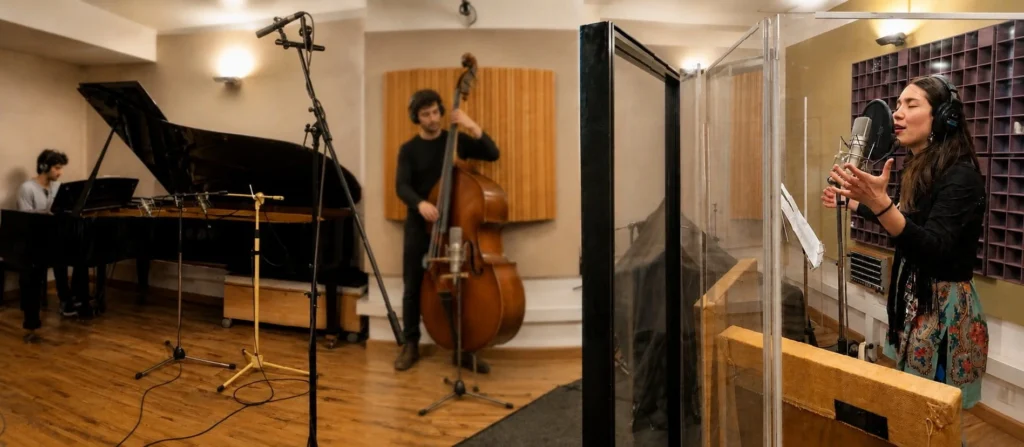
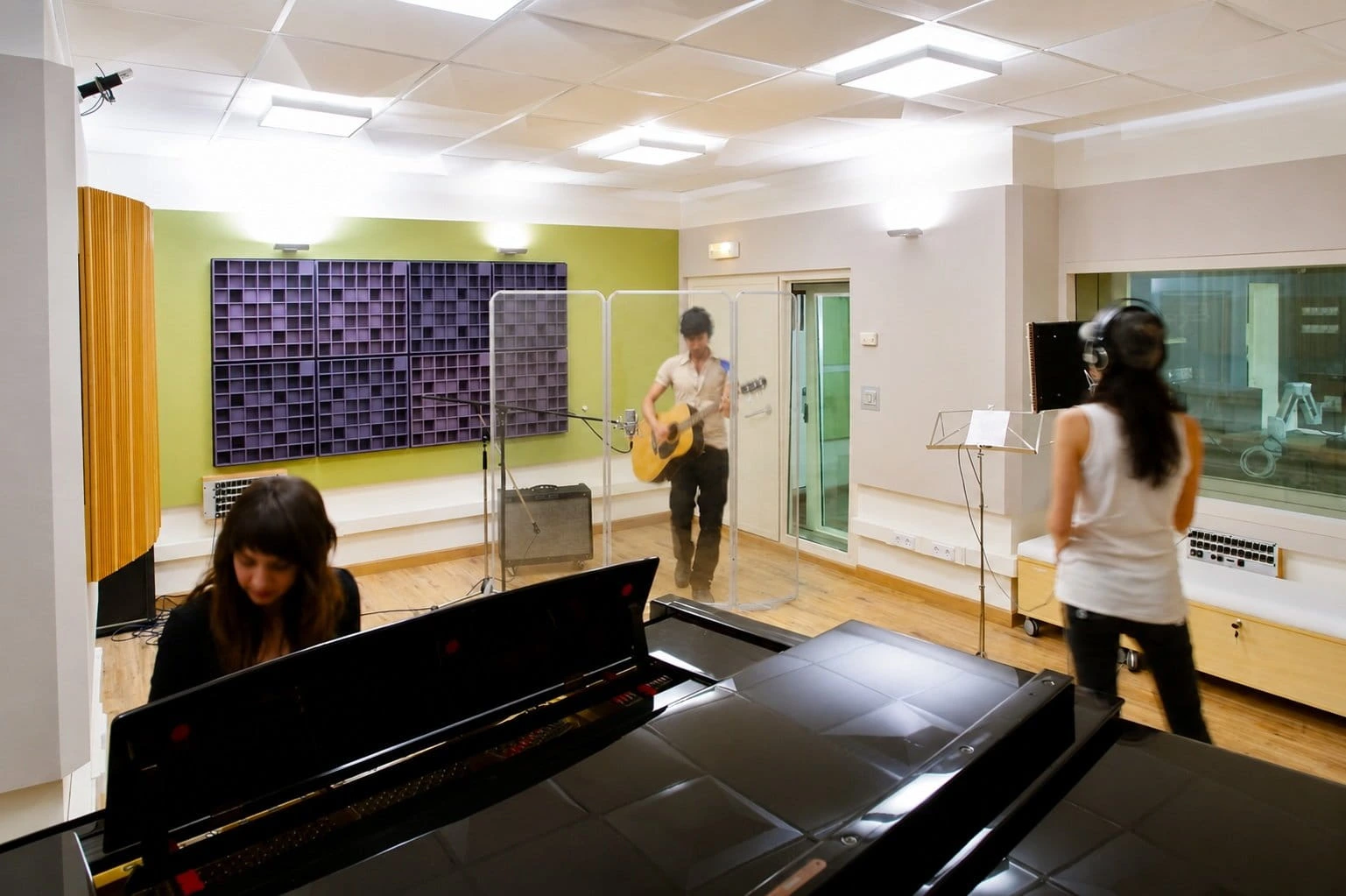
In a live recording, the layout of the room is key. We use screens to partially isolate the most sensitive sources —such as vocals or an acoustic guitar— and every musician gets their own headphone mix, set up so they can hear themselves and the rest of the band clearly. This reduces spill between microphones, keeping the sound of one instrument out of the others’ mics, without losing the feeling of playing together.
Planning the session
Studio time is limited, and good planning is the best way to make the most of it. Before the recording day, agree with the studio on:
- How many songs you want to record and in what order. Start with a song the band knows inside out: it helps everyone warm up and lets us set sounds calmly.
- What the priorities are. If time runs short, what absolutely has to be recorded today and what can wait for another session?
- The instrument list for each song: how many vocal tracks, whether there are guest musicians, whether any song changes the line-up.
- Sound references: two or three songs by other artists whose sound you like. They are far more useful than any description.
- Who makes the decisions. When five people comment on every take, the session drags. Appoint one person (or a producer) to speak to the engineer on behalf of the band.
Be realistic about timings: load-in, microphone placement and sound check are part of the session, and a properly miked drum kit takes time.
On the day of the recording
Arrive on time and leave room for loading in and setting up. Bring spares: strings, sticks, picks, batteries, cables and a spare snare head if you have one. A missing spare part can stop a whole session.
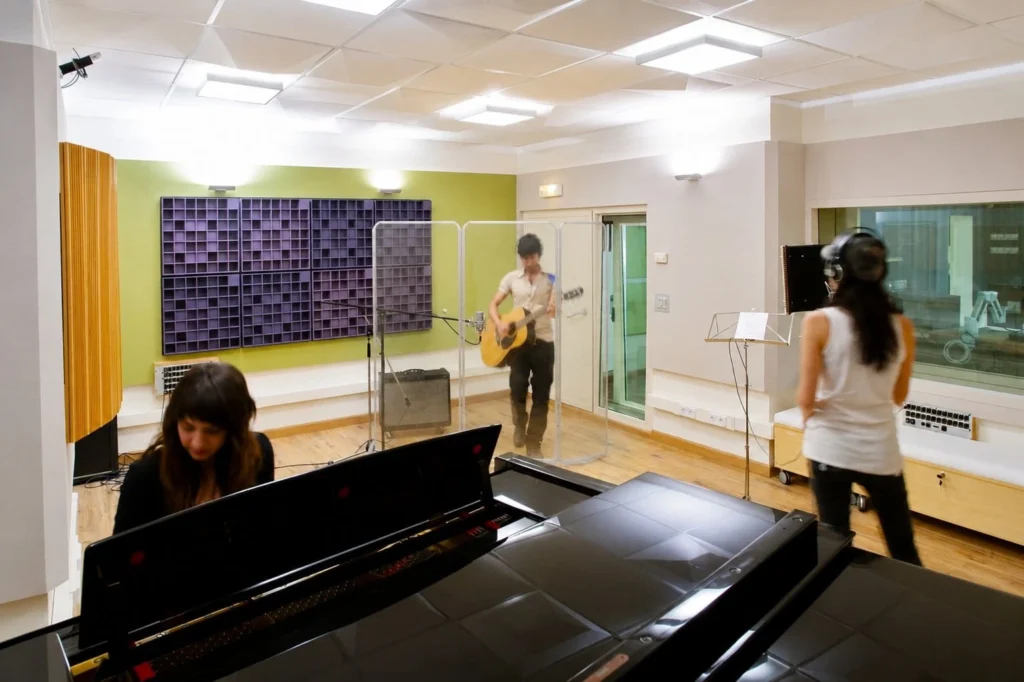
During the session, a few things that always help:
- Look after your headphone mix. If you cannot hear yourself properly, say so straight away: playing uncomfortably shows up in the recording.
- Listen to the takes in the control room, with some perspective, not only from where you play or from your own instrument.
- Do not chase the perfect take. The best performance is often one of the first ones, with energy and spontaneity. Ten more takes of the same part rarely improve it.
- Take breaks. Ears and concentration get tired. A few minutes outside the room will help you make better decisions.
- Trust the engineer. If they suggest changing a microphone or moving an amp, it is because they have heard something that can be improved before recording. Investing the time to reposition mics or adjust the setup often saves far more time later in editing and mixing.
Common mistakes to avoid
- Turning up with songs that are not finished yet.
- Discovering mid-session that you are not comfortable playing to a click.
- Using instruments with old strings or heads, or with excessive mechanical noise.
- Having no clear priorities or recording order.
- Assuming any underlying problem can be fixed in the mix. A good mix can improve a recording a great deal, but it cannot solve everything.
How we work at Sentir Studios
At Sentir Studios we work with bands from before the session even starts: we listen to your demos, talk about how you want to sound and help you decide whether it makes more sense to record all together or in stages.
We have two fully equipped studios, with room for several musicians playing together, a SONY-MCI analogue console and a wealth of high-end analogue and digital hardware, including Merging, Chiswick Reach, Avalon, Amek-Neve, SPL Goldmike, API and HearBack, alongside classic and current microphones from brands such as Telefunken, Neumann and Schoeps.
The studio is led by Lluís Molas, musician and sound engineer, working alongside musician and producer Aurelio Morata and Raül Fernández (Refree). Because we are musicians ourselves, we know what walking into a recording session feels like: we put the technique at the service of the music and make sure the band feels at home.
If you are still deciding whether to record at home or in a studio, you may find our article Home studio or professional studio: what do you really need? useful.
You will find us at C/ Casp 172, Baixos, 08013 Barcelona, in the heart of the Eixample. Visits are by prior appointment only, as we are not at the studio every day.
Frequently asked questions
How long before a session should strings and drum heads be changed?
Both new strings and new drum heads should go on a few days before the session so you can play them in, giving them time to settle and stabilise their tuning. That way you arrive with more stable instruments and we avoid fighting tunings that keep drifting during the session.
Do we have to record to a click track?
No. Many styles sound better without a click, especially when the band records live. But if you decide to use one, it is important to have rehearsed with it beforehand, because playing to a metronome for the first time in the studio usually affects the performance.
Is it better to record all together or in stages?
It depends on the style and on the result you are after. Recording all together captures the energy and interaction of the group, and it is common in jazz and acoustic line-ups. Recording in stages gives more control over each instrument and lets you work every part in more detail. The two approaches can also be combined.
How many songs can be recorded in one studio session?
It depends on how prepared the band is, on the number of instruments and on the recording approach. The better prepared the band arrives, the more songs can be recorded well. The best thing is to tell us about the project and plan the session together.
What should we send the studio before the session?
A demo or a recorded rehearsal, the structure and tempo of each song, the instrument list and two or three reference tracks for the sound you are looking for.
Arriving prepared is the best way to sound good
A good recording does not begin when the red light comes on, but weeks earlier, in the rehearsal room. The more groundwork you have done, the more studio time you will have for what matters: the music.
At Sentir Studios we help you prepare the session so that every hour counts. Tell us what you want to record and we will plan it together.