

Three Ways to Handle the Sound for a Gig
Have you got a concert coming up and it’s time to sort out the sound? If you’re the band, the venue may have some of the equipment and you may also have your own gear. In that case, you can choose to do the concert with the available equipment, rent part of the equipment you’re missing, or hire a complete sound system with a technician.
And if you’re the person organising or booking the concert — a company, a local festival or a private celebration — the band may tell you that they have a small PA system of their own. The question is: do we rely on their own equipment without a sound technician, or do we hire an external sound reinforcement service?
At PERCUMUSIC®, we get asked this question often, and the honest answer is that it depends. It depends on the venue, the lineup, the time available and, above all, on who will be behind the mixing desk during the concert. In this article, we explain the different options, what each one involves and how to make a decision without putting your concert at risk.
Own Sound System or Equipment Rental: What Makes Sense in Each Case?
If you’re a band playing small-format gigs, in familiar venues and with equipment you know how to operate, your own gear may be enough. Equipment rental can make sense as occasional additional support when you’re missing a specific item. On the other hand, if you’re organising a concert with a larger audience and challenging acoustic conditions, it often pays to have a complete technical service: a properly sized system, setup and a technician throughout the performance.
Option 1. Use Your Own Equipment or the Available Gear
This is the option that seems cheapest because you already have the equipment or because the venue provides some of it. And in some cases, it is perfectly valid: an acoustic duo in a small venue, a simple performance or a concert in a familiar space with an installation you already know.
When It Works
- Small lineups, with few channels and no complex monitoring requirements.
- Small, familiar indoor venues where you already know how the room sounds.
- Performances with enough time to set up, soundcheck and make the necessary adjustments.
- Events where both the organiser and the band are clear about who is responsible for the sound.
When It Falls Short
The problem is usually not just power, but everything you don’t see: stage monitors so the musicians can hear themselves, suitable microphones for each instrument, backup cabling and, above all, someone who isn’t performing while the mix needs to be adjusted.
As the number of musicians, channels, monitoring requirements or the complexity of the venue increases, so do the technical demands. In these cases, your own equipment or whatever is available may no longer be enough.
Option 2. Rent the Equipment Only
Renting equipment without a technician is an option that exists and can work in specific cases. You can rent speakers, a mixing desk, microphones, monitors or cabling, while transport, setup and operation are your responsibility.
What You Take Care of
- Transport, loading and unloading of the equipment, both ways.
- Setup and cabling, including the time required before soundcheck.
- System configuration: gain, equalisation, monitors…
- Dealing with problems live: a faulty channel, feedback or any other issue that appears during the performance.
- Responsibility for equipment that does not belong to you.
When It Makes Sense
In our experience, equipment rental usually works well as occasional additional support: you are missing two monitors, you need a subwoofer for a larger-than-expected venue, or you want to complete a system you already have and know how to operate.
On the other hand, when rental is the entire technical solution for a concert, what you save on the invoice can end up costing you in hours, stress and risk. And on the day of the gig, there is no going back from that risk.
Option 3. Complete Technical Service
This is the option we recommend when a concert requires a certain level of technical complexity, and not simply because it means selling more: because it allows musicians to focus on performing and the organisers to avoid taking on the technical responsibility for the concert.
A complete service includes a sound system and monitors properly sized for the venue, microphones suited to the lineup, transport, setup and dismantling, soundcheck with the musicians and a sound technician present throughout the performance. Lighting can be added depending on the type of event.
We explain this way of working in detail on the sound reinforcement and lighting service page, and if you want to understand how the price is calculated, we break it down in how much it costs to provide sound reinforcement for a small-format concert.
The Five Factors That Decide for You
Before choosing an option, it’s worth looking at these five points. The more complex the situation, the more sense it makes to have an appropriate system and technician.
1. Audience Capacity and Venue Geometry
A long outdoor space, a square surrounded by façades or a room with columns cannot simply be solved by adding more volume. You often need to distribute the sound across more emission points and, in distant areas, add delay reinforcement systems so that the sound arrives aligned, more evenly and synchronised.
This is not just a question of equipment: it is a question of technical judgement.
2. Channels and the Technical Rider
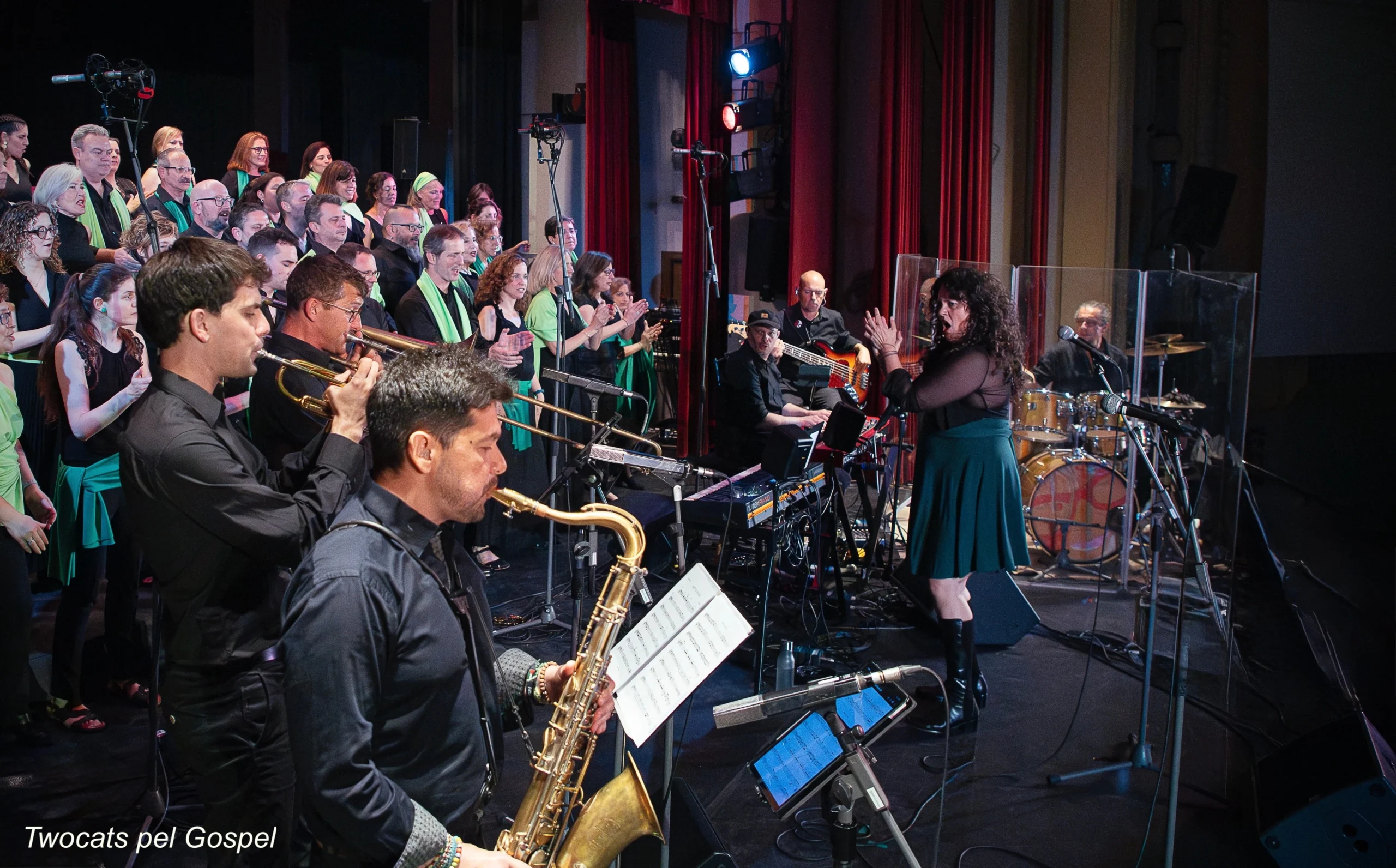
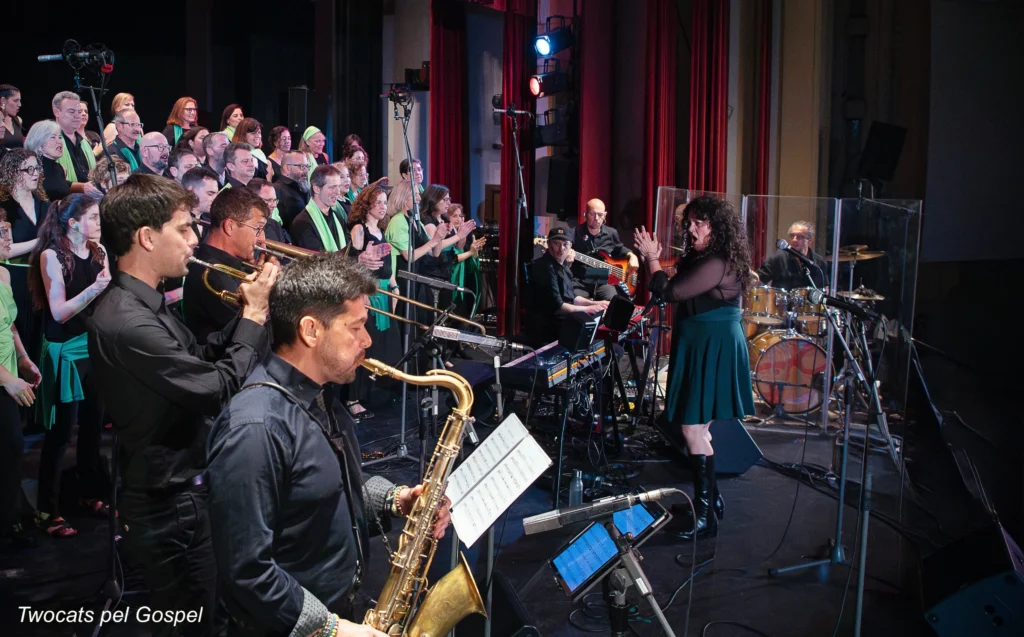
A singer-songwriter with vocals and guitar may need very few channels. A band with drums, bass, keyboards, guitars and vocals may need many more, and if there is a brass section, backing vocals or other instruments, the requirements increase.
Each channel involves microphones or connections, stands, cabling, soundcheck time and a more demanding mix. That is why it is important to review the lineup’s technical rider before deciding what equipment is needed.
3. Where the FOH Control Is Located
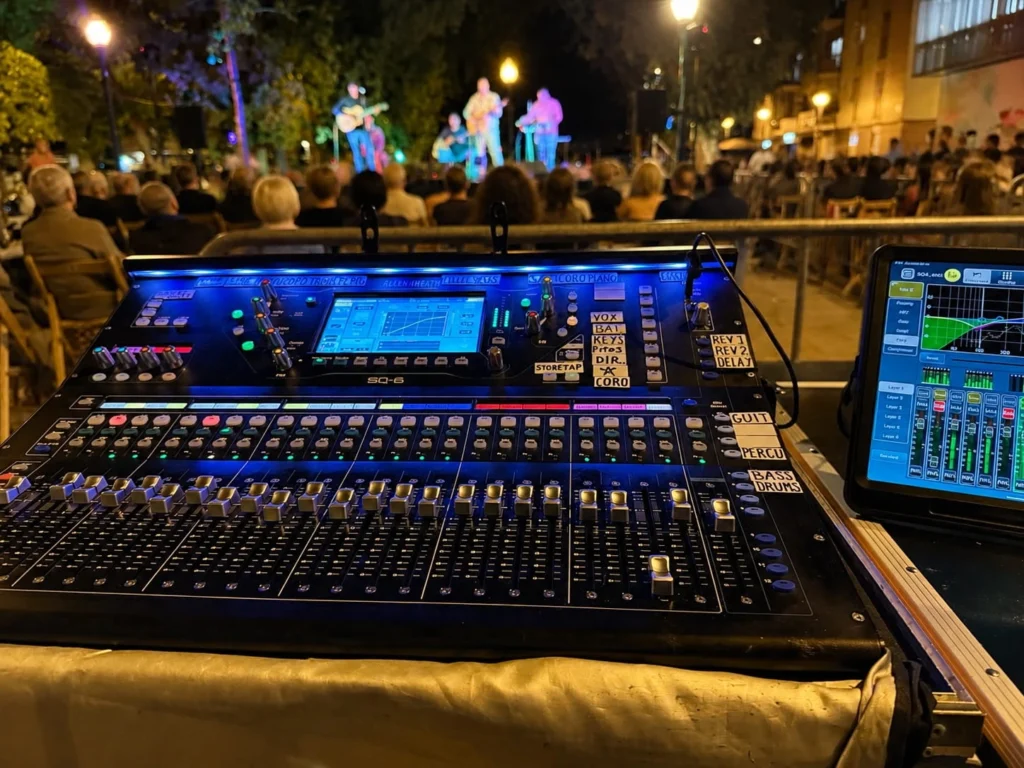
Whenever possible, the mixing desk should be positioned in front of the stage, where the technician can hear the same thing as the audience. This allows much more precise mixing decisions.
When the organisation or venue does not allow this and the technician has to work from the side or another location, remote tablet control makes it possible to move around the room and check how the sound reaches different areas of the audience.
4. Lighting
It is optional, but it can completely change how the show is perceived. With DMX control, scenes can be prepared and the lighting adapted live to each moment of the concert. Haze or smoke machines make the light beams more visible and enhance the effect of each fixture.
Renting lighting fixtures is easy; getting the lighting properly integrated with the performance and changes in atmosphere requires some planning and someone to program and operate it.
5. Time and Logistics
Set up, cable, soundcheck, perform and dismantle. If the band has to do all five things, they will reach the last one exhausted and the first one under pressure.
And if you are organising the concert, you also need to consider loading and unloading times, access, available space and the time required for soundcheck. Logistics affect the result just as much as the equipment.
Quick Comparison
| Aspect | Own / Available Equipment | Equipment Rental | Complete Technical Service |
|---|---|---|---|
| Ideal for | Small formats and simple situations | Occasionally supplementing equipment you already have | Concerts with greater technical demands |
| Who sets up | The band or organisation | The band or organisation | The technical team |
| Who mixes | The band or someone from the organisation | The band or someone from the organisation | Dedicated sound technician |
| Monitors and stage returns | Depending on the available equipment | Depending on what is rented | Sized for the lineup |
| Live issues | Handled internally | Your responsibility | Handled by the technician |
| Technical responsibility | Band / organisation | Band / organisation | Technical team |
What If the Band Already Has Its Own Sound Technician?
This happens often, and it is good news. In these cases, we can provide the system and our knowledge of the venue, while the work is done by coordinating with the band’s technician.
We prepare the system, leave the desk and connections ready and handle the logistics so their technician can focus on the mix. They know the band; we know the equipment and the venue. The combination of the two is what makes a concert sound right.
The One Factor You Can’t Rent
You can rent a PA, a mixing desk and eight microphones. What you cannot rent is the expertise of the person behind them.
Knowing how to interpret what each musician needs, anticipate problems, adapt the mix to what is happening on stage or check how the sound changes as the room fills up are all part of a technician’s experience.
At PERCUMUSIC®, we are musicians providing sound for musicians. We have been on the other side of the desk and know what it is like to step onto a stage without being able to hear yourself properly. That is why we don’t simply make equipment produce sound: we look at what each lineup and venue needs, and put the technology at the service of the music.
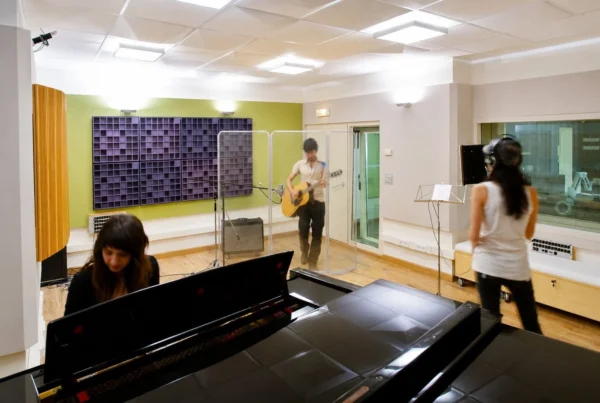
And if your project continues beyond the live performance, we have Sentir Estudis, our recording studio in central Barcelona. Visits are by appointment only, because we are not there every day. You can see our services on the Sentir Estudis page.
Frequently Asked Questions
What is better: renting sound equipment or hiring a technical service?
It depends on the concert. For a simple performance, with equipment you already know and know how to operate, rental may be enough. When technical requirements, audience capacity, venue complexity or the organiser’s responsibility increase, a complete technical service provides greater assurance.
Can I just rent the speakers and set everything up myself?
Yes, you can. It makes sense as occasional additional support when you already have equipment and know how to operate it. If rental is the entire technical solution for the concert, you take responsibility for transport, setup, configuration, mixing and any live issues.
How large does a band need to be before I need a sound technician?
There is no magic number. More than the number of musicians, you need to consider the number of channels, monitoring, the venue, audience capacity and the complexity of the performance. A small band may need a technician in a demanding venue, while a simpler performance may work without one.
If our band already has a technician, can we hire you just for the equipment?
Yes. We prepare the system, configure it and coordinate with your technician so that the desk and connections are ready. It is a formula that works well when the band’s technician knows the lineup inside out.
Is it cheaper to bring our own equipment?
On the invoice, yes. But you also need to consider preparation time, transport, equipment wear and tear, and responsibility for any problems. It is worth comparing the total cost, not just the rental price.
Let’s Talk About Your Concert
Tell us the date, venue, audience capacity and lineup, and we’ll honestly tell you which option makes sense for you, even if it is the simplest one. We’ll prepare a tailored, no-obligation proposal.
Technology at the service of music.